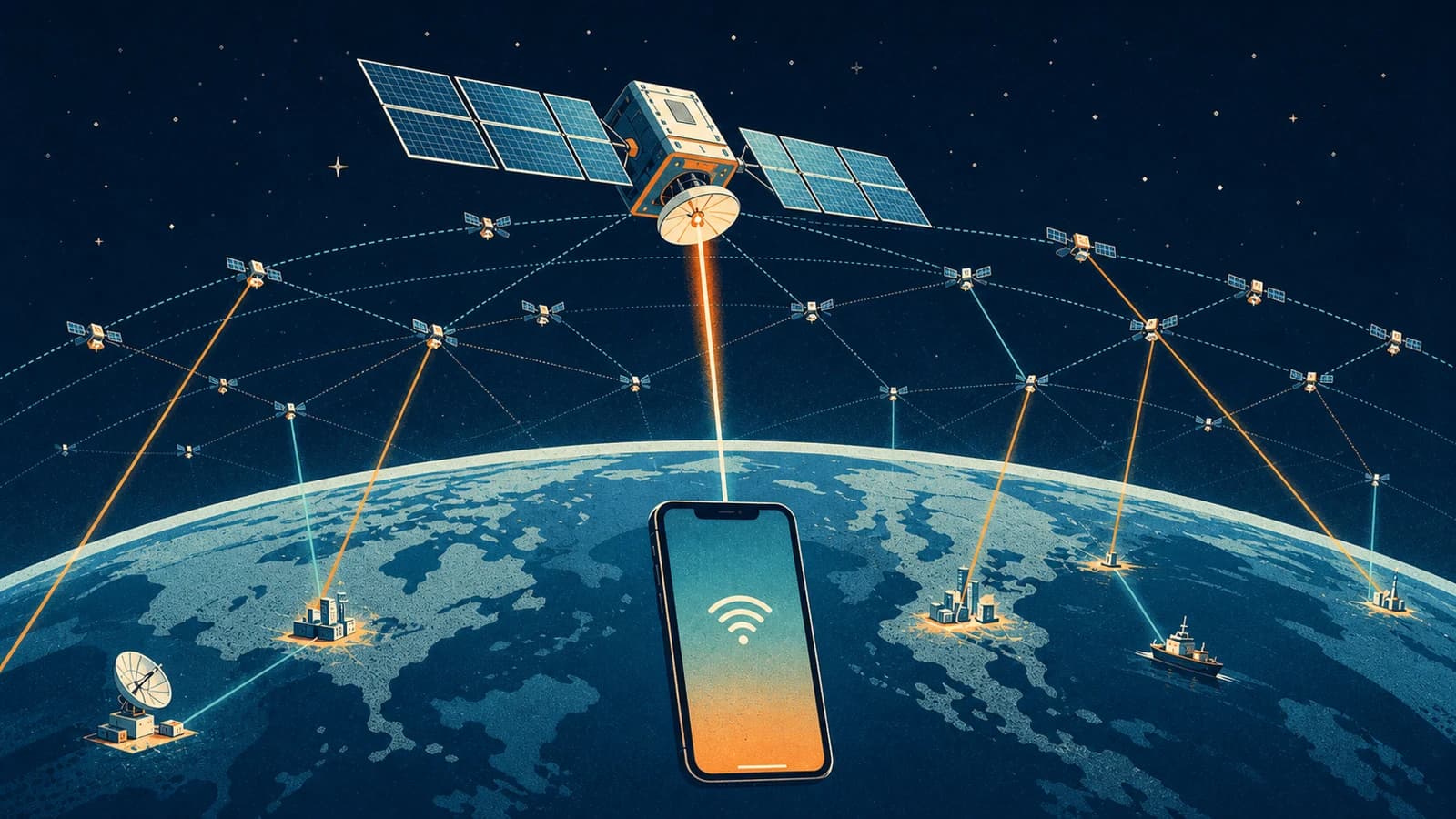
The proposed Amazon Leo network would use Globalstar spectrum and begin satellite deployment in 2028. It would operate alongside Amazon's existing broadband constellation.
Amazon Leo filed an application with the U.S. Federal Communications Commission on July 27, 2026, seeking authority to launch and operate up to 5,105 low Earth orbit satellites. The proposed Direct-to-Device system is designed to provide voice, messaging, data and emergency services directly to compatible mobile devices, with satellite deployment scheduled to begin in 2028.
The application starts a regulatory review rather than granting Amazon permission to deploy the network. Reuters reported that Amazon asked the FCC for prompt approval and that the agency did not immediately comment on the proposal.
A separate network for direct mobile connections
The proposed D2D constellation is separate from Amazon Leo's first- and second-generation broadband satellite systems. Amazon says the new satellites would operate alongside those networks and Globalstar's existing HIBLEO and C-3 constellations.
Amazon's core broadband service connects customers through dedicated antennas called Leo Nano, Leo Pro and Leo Ultra. The D2D system instead targets compatible smartphones and other mobile devices, including devices with satellite-capable chipsets. Amazon plans to provide the service in partnership with mobile network operators.
The company listed voice calls, messaging, data and emergency communications among the planned services. It also described potential uses including disaster response, remote industrial operations, fleet management and connections for sensors outside the reach of terrestrial networks.
Five orbital shells between 510 and 580 kilometers
Amazon's filing divides the proposed satellites among five orbital shells. Three are designed for mid-latitude coverage, one extends service to higher latitudes, and one approaches polar coverage.
| Orbit group | Altitude | Inclination | Planned coverage |
|---|---|---|---|
| Shell 1 | 580 km | 55.7° | Mid-latitudes |
| Shell 2 | 560 km | 58.2° | Mid-latitudes |
| Shell 3 | 510 km | 56.3° | Mid-latitudes |
| Shell 4 | 570 km | 73.0° | Higher latitudes |
| Shell 5 | 540 km | 84.0° | Near-polar regions |
The satellites would communicate with mobile devices through L-band and S-band frequencies. Separate Ka-band and V-band links would carry aggregated traffic between the satellites, Amazon's ground stations and the internet.
Amazon says the satellites would process signals in orbit instead of serving only as relays. The design also includes optical links between satellites, digital beamforming and beam-hopping technology to direct capacity toward specific locations.
The plan uses Globalstar spectrum
The application follows Amazon's April 2026 agreement to acquire Globalstar's satellite operations, infrastructure and spectrum assets. Amazon plans to use Globalstar's mobile satellite service spectrum for the new D2D network.
Globalstar already supports satellite features for millions of Apple devices, including emergency messaging, location sharing and roadside assistance outside terrestrial network coverage. Amazon said its proposed system would operate alongside Globalstar's existing constellations rather than replacing them.
Reuters identified SpaceX, AST SpaceMobile and Lynk Global as other companies developing satellite-to-phone services. Amazon Leo has separately announced agreements with Vodafone, DirecTV, Herotel and Australia's National Broadband Network for its broader satellite connectivity business.
Amazon has more than 390 broadband satellites in orbit
The new application comes while Amazon continues to deploy its first-generation broadband constellation. The company said it has more than 390 Amazon Leo satellites in orbit and enough coverage to start introducing fixed broadband service across initial latitude bands later in 2026.
Those existing satellites belong to the broadband network, not the newly proposed 5,105-satellite D2D constellation. Deployment of the direct-to-device satellites is scheduled to begin in 2028, subject to regulatory approval.