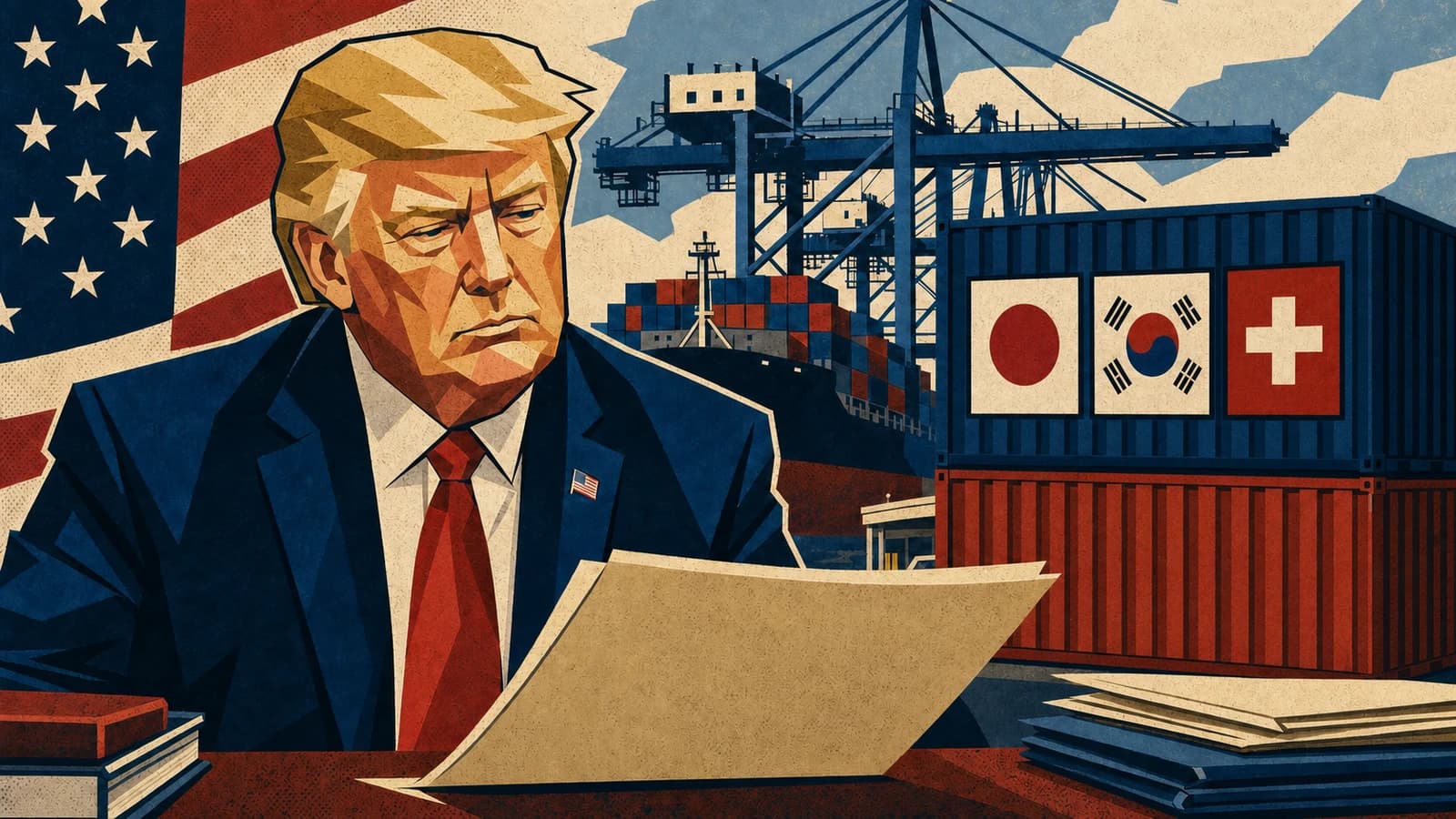
New U.S. Section 301 tariffs took effect on July 24. Japan, South Korea and Switzerland were placed under the same MFN-inclusive 12.5% tariff formula.
The Office of the U.S. Trade Representative announced final Section 301 actions covering 60 economies on July 23, 2026. Japan, South Korea and Switzerland were placed under the same tariff formula: for non-exempt goods, the existing most-favored-nation duty and the new Section 301 duty are combined at 12.5%. The actions took effect at 12:01 a.m. U.S. Eastern time on July 24.
USTR said the investigations examined whether each economy imposed and effectively enforced a ban on imports made wholly or partly with forced labor. The agency said the 60 covered trading partners account for 99.4% of U.S. imports.
Tariff treatment is divided into four groups
The final action uses four tariff calculations for non-exempt goods.
| Treatment | Economies | Section 301 calculation |
|---|---|---|
| Additional 10% duty | 17 economies, including Canada, Mexico, India, and the United Kingdom | The 10% Section 301 duty is added to the existing most-favored-nation duty |
| Combined rate of 10% | European Union and Taiwan | The Section 301 duty fills the gap between the MFN rate and 10%; it is zero when the MFN rate is at least 10% |
| Combined rate of 12.5% | Japan, South Korea, and Switzerland | The Section 301 duty fills the gap between the MFN rate and 12.5%; it is zero when the MFN rate is at least 12.5% |
| Additional 12.5% duty | The remaining 38 economies, including Australia, Brazil, China, and Vietnam | The 12.5% Section 301 duty is added to the existing MFN duty |
For non-exempt goods from Japan, South Korea or Switzerland with an MFN rate below 12.5%, the new Section 301 duty equals the difference between that rate and 12.5%. If the MFN rate is already 12.5% or higher, the Section 301 duty under this action is zero.
Section 232 goods and listed products are exempt
The action does not cover informational materials, donations, accompanied baggage, or articles and parts already subject to tariffs under Section 232 of the Trade Expansion Act. USTR also published economy-specific exemptions for raw materials, products that could cause economy-wide disruption, goods that the United States cannot produce in sufficient quantities or at reasonable prices, and products for which the tariff may not advance the stated purpose of the investigation.
The duties apply to goods entered for consumption or withdrawn from a warehouse for consumption from 12:01 a.m. Eastern time on July 24. Goods already loaded on a vessel and in their final mode of transit before that time are exempt if they enter the United States before 12:01 a.m. Eastern time on July 28.
The presidential memorandum also directs USTR to establish three-year tariff-rate quotas for certain textile and apparel imports from Bangladesh, Cambodia, Indonesia, and Malaysia when implementation becomes feasible. Until those quotas begin, the relevant imports remain subject to the 10% rate.
Trading partners responded to the findings
Australia’s trade minister rejected the U.S. allegation and the 12.5% treatment applied to Australian goods. New Zealand’s prime minister also objected to the measure. Japan’s chief cabinet secretary said the decision was regrettable and that Japanese trade and industry comply with international rules. The European Union’s foreign policy chief questioned the U.S. rationale by pointing to the bloc’s labor standards.
South Korea’s trade ministry said the MFN-inclusive 12.5% treatment confirmed the structure announced for Korean goods. The ministry said it had asked the United States to preserve the balance of benefits in the existing bilateral trade agreement and emphasized that the forced-labor action and any separate overcapacity action should not push the overall tariff rate above 15%.
According to the ministry, the U.S. side reaffirmed that the existing trade agreement should be observed. The separate U.S. Section 301 investigation into structural overcapacity remains in progress.