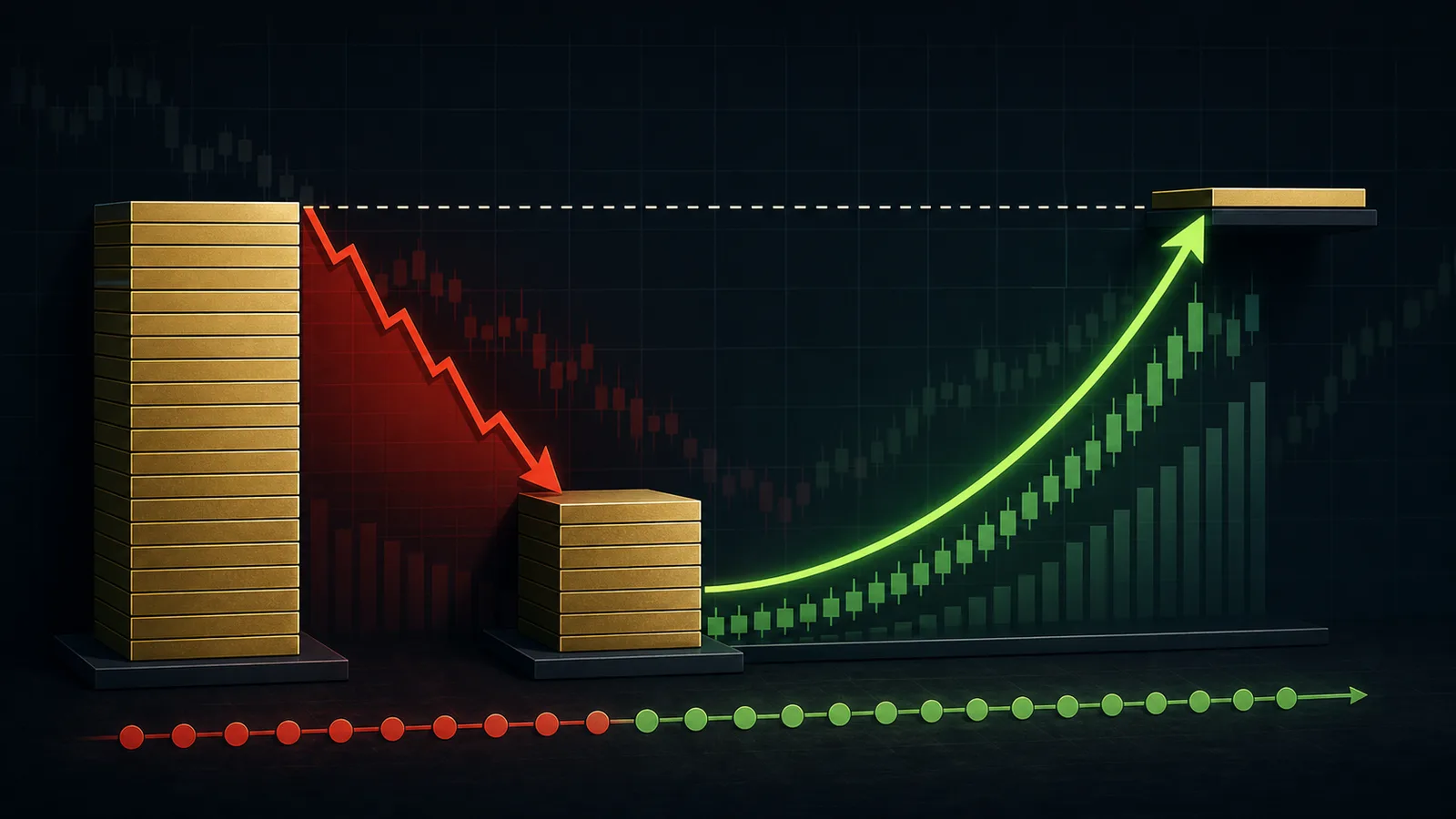
If $1,000 falls to $500 after a 50% loss, recovering to $1,000 in 100 days requires about 0.6956% a day compounded.
If $1,000 falls by 50%, the account is left with $500. Getting back to the original $1,000 means the remaining money has to double.
That is already a +100% recovery return. But the question changes again if the recovery has to happen within a fixed period. To recover a 50% loss in 100 days, $500 must grow back to $1,000 through daily compounding.
The calculation uses $500 as the current amount, $1,000 as the target, and 100 days as the recovery period.
| Recovery period | Daily compound return needed |
|---|---|
| 30 days | 2.3374% |
| 50 days | 1.3959% |
| 100 days | 0.6956% |
| 200 days | 0.3472% |
| 365 days | 0.1901% |
The same loss feels different when the deadline changes
The total recovery target is the same in every row. The money still has to go from $500 back to $1,000. What changes is the number of days available.
If the recovery period is short, each day has to do more work. In 30 days, the required daily compound return is about 2.3374%. In 100 days, it is about 0.6956%. Over 365 days, it falls to about 0.1901%.
This is not a forecast that such a recovery will happen. Real stocks can move unevenly, and a losing account can fall further before it recovers. Fees, taxes, volatility, liquidity, and additional deposits are not included.
The point is narrower: a loss recovery question is not only about how much return is needed in total. It is also about how quickly the money needs to recover. The shorter the deadline, the heavier the daily return requirement becomes.