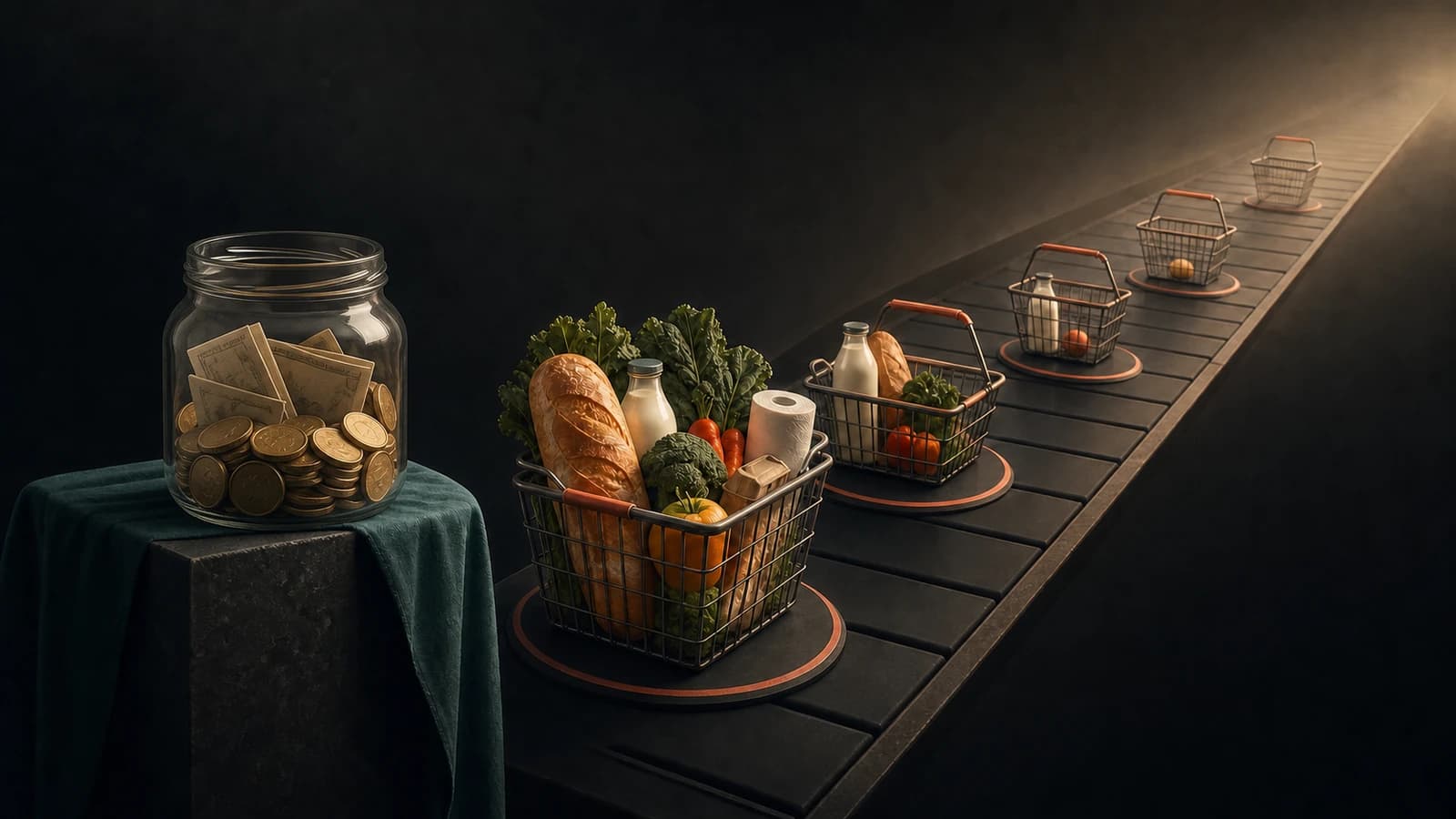
After 10 years of 3% inflation, $100,000 has the purchasing power of about $74,409 today. Keeping pace requires about $134,392 in future dollars.
A bank balance can stay at $100,000 for a decade and still lose value. If prices rise 3% a year, the number in the account does not change—but what that money can buy does.
After 10 years of 3% inflation, $100,000 has the same purchasing power as about $74,409 today. That is a 25.6% loss of purchasing power even though no dollars left the account.
The balance is unchanged; its real value is not
To express a future amount in today's dollars, divide it by the cumulative increase in prices:
With inflation fixed at 3%, the decline builds year by year.
| Time | Value of $100,000 in today's dollars | Purchasing power lost |
|---|---|---|
| After 1 year | about $97,087 | about 2.9% |
| After 2 years | about $94,260 | about 5.7% |
| After 3 years | about $91,514 | about 8.5% |
| After 4 years | about $88,849 | about 11.2% |
| After 5 years | about $86,261 | about 13.7% |
| After 6 years | about $83,748 | about 16.3% |
| After 7 years | about $81,309 | about 18.7% |
| After 8 years | about $78,941 | about 21.1% |
| After 9 years | about $76,642 | about 23.4% |
| After 10 years | about $74,409 | about 25.6% |
The first year removes about $2,913 of purchasing power. The gap grows to about $13,739 after five years and $25,591 after 10. The account still says $100,000, but the amount it can buy keeps shrinking.
Why a decade at 3% is not simply a 30% loss
Inflation compounds. The second year's 3% increase applies to prices that already rose in the first year.
At 3% a year, the price level rises by about 34.4% over 10 years. Purchasing power moves in the opposite direction, but it does not fall by 34.4%. It falls to the reciprocal of that higher price level: about 74.4% of its starting value.
Suppose a group of goods costs $100,000 today. If its price rises with 3% annual inflation, it would cost about $134,392 in 10 years. A $100,000 balance at that point would cover only about 74.4% of the same purchase.
Preserving today's $100,000 takes about $134,392
For a deposit, the relevant number is its interest rate. For an invested asset, it is the nominal return. What matters is whether the return after taxes and fees keeps up with inflation.
With inflation fixed at 3% and no taxes or fees, the money would need to grow by 3% a year to maintain its purchasing power:
A 0% return preserves the account balance. It does not preserve what the balance can buy. Taxes and fees would push the required gross return above 3%.
See $100,000 grow to the nominal amount needed
ReturnLab's public calculator does not currently subtract inflation to show value in today's dollars. The link checks the other side of the equation: the nominal growth required for $100,000 to keep pace with 3% annual inflation for 10 years.
This is a scenario, not an inflation forecast
Inflation rarely holds at one rate for 10 straight years. Personal inflation also differs by spending pattern: housing, food, healthcare, education, and other categories can move at different speeds.
The $74,409 and $134,392 figures are therefore outputs of a fixed 3% scenario, not predictions. The calculation excludes taxes, fees, exchange rates, and investment volatility. It is an educational example, not investment advice.