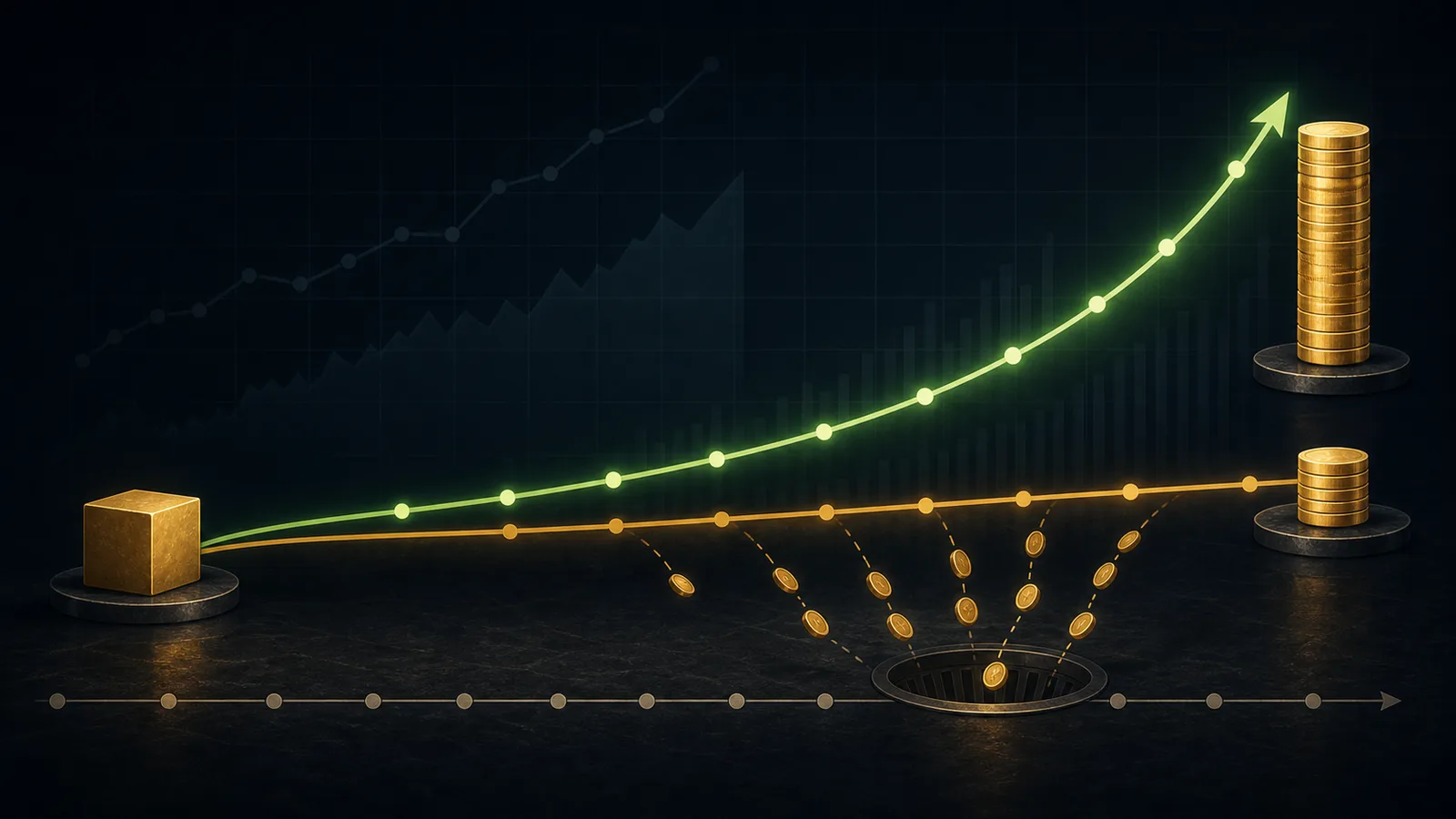
$10,000 at 8% for 30 years becomes about $100,627. At 7%, it becomes about $76,123. That 1% gap costs about $24,504.
Suppose you invest $10,000 for 30 years.
If the money compounds at 8% a year, it grows to about $100,627. If a 1% annual cost lowers the effective return to 7%, the same money grows to about $76,123.
The difference is about $24,504.
That is the part that is easy to miss. A 1% fee does not only take a small slice in one year. It also lowers the amount of money that can compound in every year after that.
| Period | 8% annual return | 7% annual return | Difference |
|---|---|---|---|
| 10 years | $21,589 | $19,672 | $1,918 |
| 20 years | $46,610 | $38,697 | $7,913 |
| 30 years | $100,627 | $76,123 | $24,504 |
| 40 years | $217,245 | $149,745 | $67,501 |
In the first 10 years, the gap is about $1,918. That is not small, but it may still feel manageable compared with the original $10,000.
After 30 years, the gap is larger than twice the original investment. After 40 years, the gap is about $67,501.
The reason is simple. The account with the lower return starts each following year from a smaller base. That smaller base earns less, and the gap becomes part of the next year's starting point.
At 8% for 30 years, $10,000 becomes about 10.06 times the original money. At 7%, it becomes about 7.61 times. The return gap is only one percentage point, but the final money is about 24.35% lower.
This does not mean every low-fee product is automatically better, and it does not mean every high-fee product is bad. Real investments can include taxes, tracking error, fund structure, trading costs, currency risk, and different levels of risk.
But if two investments produce similar results before cost, a repeated 1% annual fee can take a very visible amount of money from the final account value.