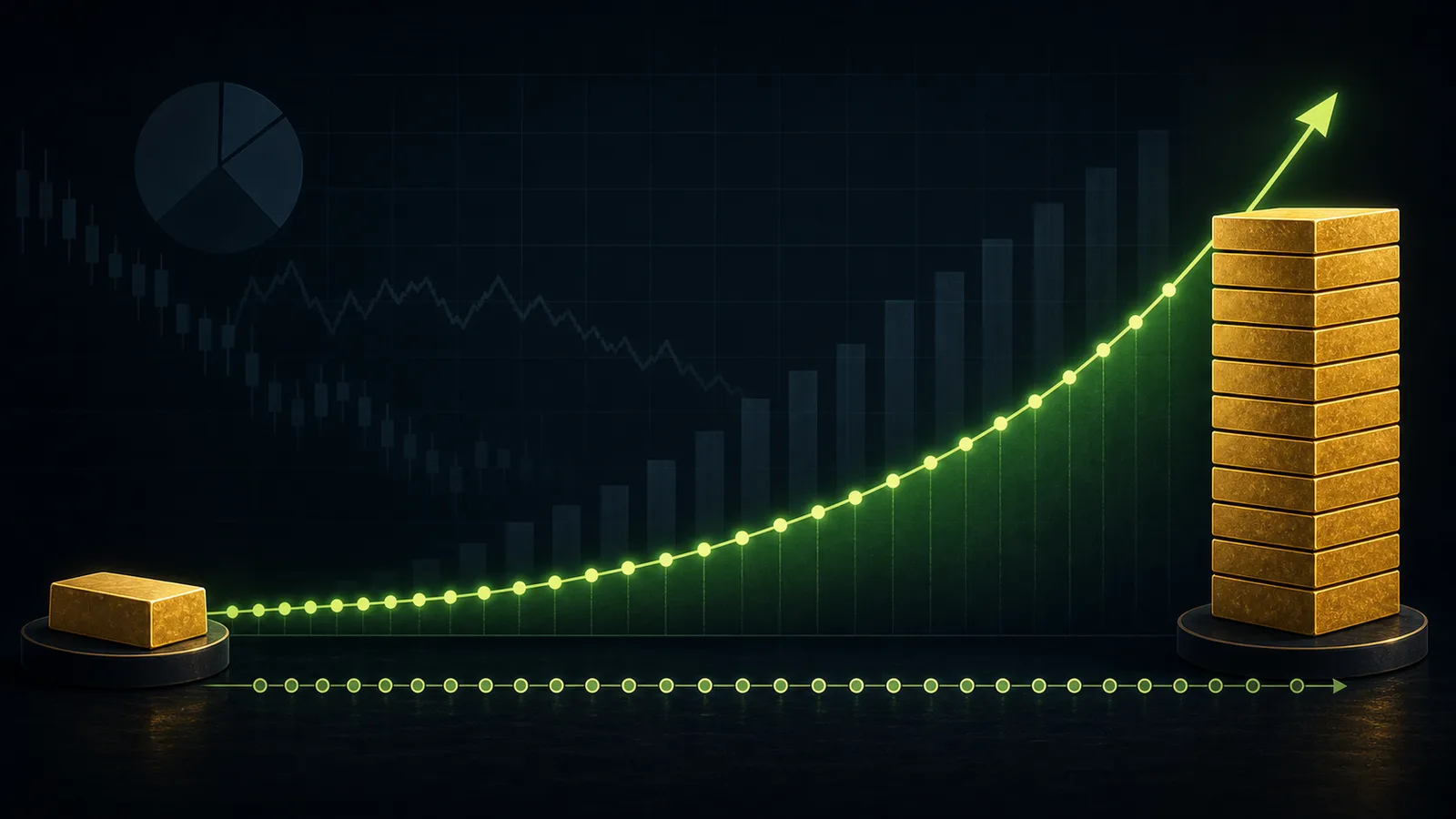
$1,000 at 0.5% a day for 100 days becomes about $1,647. At 0.7% a day, it becomes about $2,009.
A daily return of 0.5% does not look dramatic on the first day. On $1,000, it is only $5. But if the same return compounds for 100 days, the final money is much larger than the first day suggests.
At 0.5% a day for 100 days, $1,000 becomes about $1,647. The profit is about $647, and the final amount is about 1.65 times the original principal.
Here is the same starting money over 100 days with 0.3%, 0.5%, and 0.7% daily returns.
| Daily return | Final amount after 100 days | Profit | Multiple of principal |
|---|---|---|---|
| 0.3% | $1,349 | $349 | 1.35x |
| 0.5% | $1,647 | $647 | 1.65x |
| 0.7% | $2,009 | $1,009 | 2.01x |
Why 100 days is enough to show compounding
The first day's 0.5% return is only $5 on $1,000. If you treated that as simple interest, 100 days would look like about $500 of profit.
Compound return changes the base. After the first day, the money is no longer exactly $1,000. The next day's return is calculated on the slightly larger amount, and this repeats for 100 days.
That is why the 0.5% case ends near $1,647 instead of exactly $1,500. At 0.7%, the same 100-day period pushes the money slightly above 2x.
This is not a claim that a 0.5% daily return is easy or stable. Real markets include losing days, fees, taxes, volatility, and execution limits. This is a calculation example for seeing how daily return, principal, and a 100-day period interact.